Managing Disparate Systems in Hybrid Ecosystems
Complex corporate operations rarely reside within a single codebase or homogeneous cloud provider. Instead, organizations grapple with fragmented software estates containing mainframe databases, localized inventory systems, and multi-tenant SaaS tools. When everyday business initiatives cut through these disconnected silos, teams rely on fragmented manual handoffs, ad-hoc email confirmations, or unmonitored scripts. These stopgap solutions obscure progress visibility, create data discrepancies, and leave operations teams guessing about the true state of cross-department deliverables.
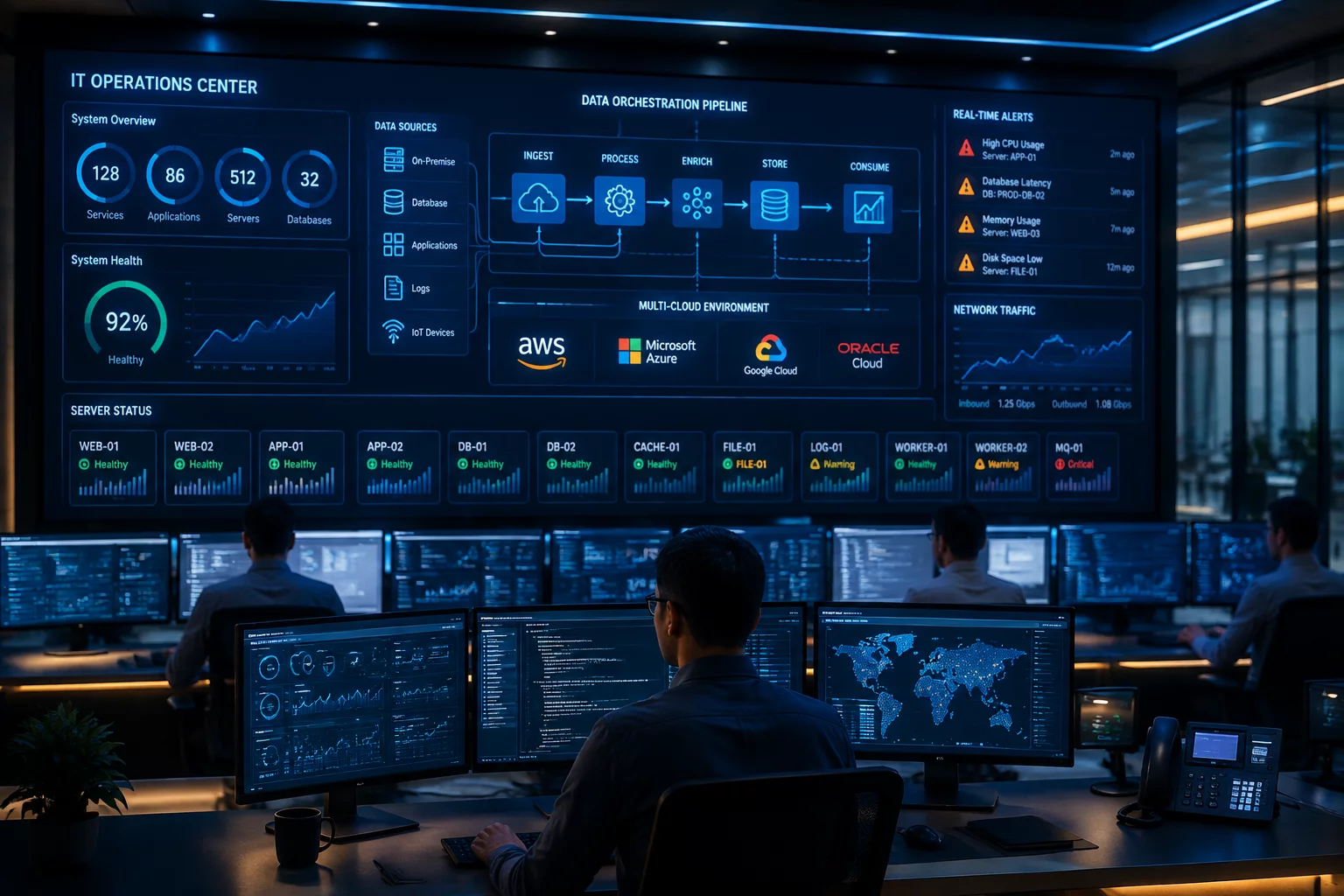
Enterprise workflow orchestration provides a resilient supervisory plane above this fragmentation. It abstracts task progression away from individual applications into unified state machines. Rather than allowing tasks to stall silently inside an unread support mailbox, an orchestrator coordinates asynchronous triggers, validates transaction prerequisites, and dispatches instructions strictly when dependencies resolve. By standardizing transition definitions across departments, companies transform fragile software integrations into predictable, self-documenting assembly pipelines.
Audit Your Operational Transition Lanes
Evaluate existing handoff protocols and eliminate bottlenecks between hybrid systems with our technical integration blueprints.
Empirical Benchmarks & Efficiency Gains
Transitioning from siloed task exchanges to centralized orchestration engines yields measurable improvements in transaction speed and incident prevention. Field data collected across enterprise rollouts illustrates the performance delta between uncoordinated operational handoffs and standardized orchestrator control.
| Operational Parameter | Observed Specification | Target Benchmark |
|---|---|---|
| Cross-system state synchronization latency | 48 minutes average queue lag | Under 150 milliseconds |
| Unhandled exception fallout rate | 14.8% manual ticket creation | Under 0.4% automatic retry catch |
| End-to-end task execution traceability | 34% fragmented audit trails | 100% centralized log ingestion |
| Incident MTTR on failed handoffs | 4.2 hours resolution cycle | 8.5 minutes alert-to-rollback |
Deployment Architecture & Execution Protocols
A scalable orchestration layer separates business logic from execution workers. When transactions span ERP backends, customer communication systems, and analytics ledgers, every constituent event functions as an idempotent task. This ensures operations can be safely re-executed if network interruptions occur during transmission.
Essential Operational Safeguards
Robust orchestration platforms enforce rigorous state boundaries to prevent silent dropouts and inconsistent records across operational nodes:
- Enforce strict JSON schema validation and cryptographic validation on every inbound job payload before dispatching tasks to downstream workers.
- Implement bounded exponential backoff policies accompanied by dedicated dead-letter queues to catch persistent API connection timeouts.
- Maintain distributed transactional saga coordinators that execute compensating rollbacks whenever terminal steps reject data.